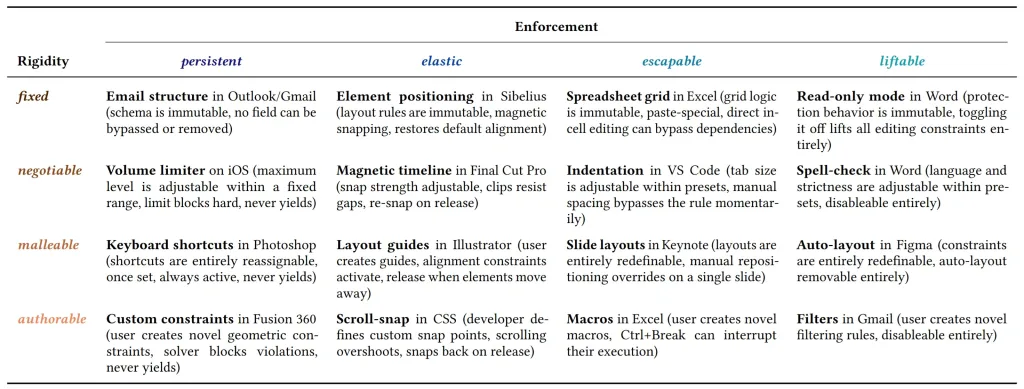
User interfaces rely on rules that govern how users create, organize, and transform content. We call these rules structure. While structure enables functionality, its rigid enforcement often conflicts with user intentions, particularly in productivity and creative workflows. As generative systems increasingly produce and adapt structure on behalf of users, there is a clear need for a vocabulary to reason about structural behavior. We introduce Structural Interaction, a framework that makes structure a primary object of design. We model the user interface as a directed graph of elements and rules, and characterize rule behavior along two orthogonal dimensions: rigidity (how much a rule can be shaped) and enforcement (how much it can yield during interaction). Four values per dimension generate a 16-cell design space. Through two use cases, we show how the framework diagnoses structural limitations in existing interfaces and guides the design of solutions operating independently on each dimension.
V. Cavez, K. Imteyaz, A.-F. Cabouat. In Companion Publication of the 2026 ACM Designing Interactive Systems Conference (DIS ’26 Companion).
(This work has been accepted to DIS ’26 and will be presented in June)